
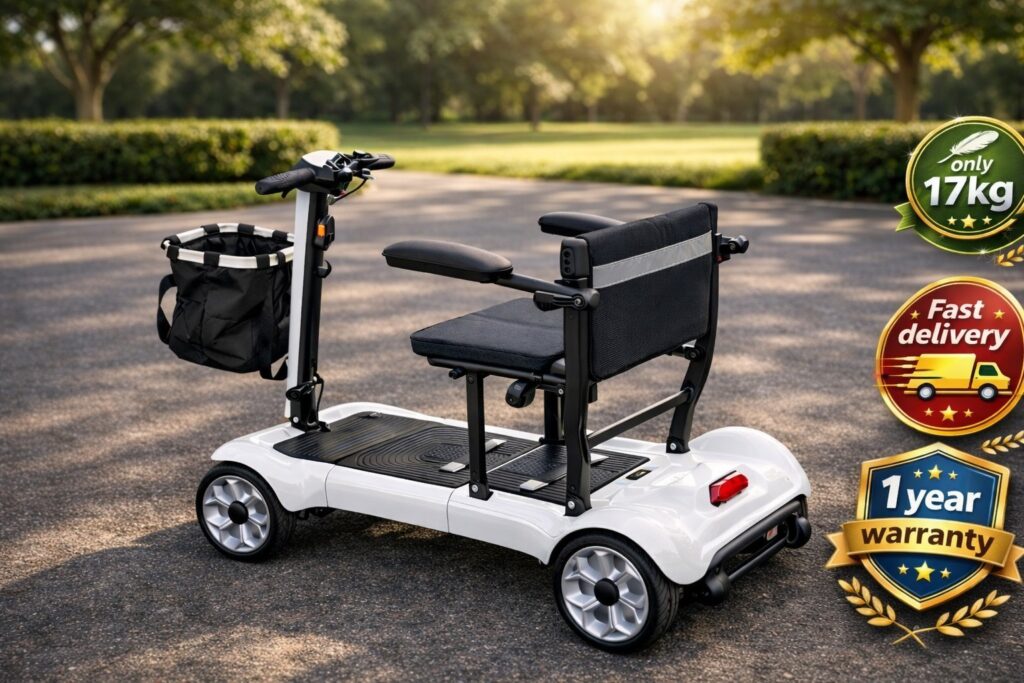
If you’re researching mobility scooters in the UK, you’ll quickly come across two legal categories:
- Class 2
- Class 3
Understanding the difference is essential before buying — because it affects where you can legally travel, how fast you can go, and whether registration is required.
Let’s break it down clearly.
What Is a Class 2 Mobility Scooter?
Class 2 scooters are often called pavement scooters.
They are:
- Limited to 4mph
- Designed for pavement use
- Not intended for road travel (except crossing)
- Not required to be registered with the DVLA
Most lightweight, folding and portable mobility scooters fall into this category.
Ideal For:
- Supermarket trips
- Town centres
- Local errands
- Travel and car boot transport
- Users prioritising portability
Because they are compact and lightweight, Class 2 scooters are easier to store and transport.
What Is a Class 3 Mobility Scooter?
Class 3 scooters are larger, road-capable models.
They:
- Can travel up to 8mph
- May be used on roads (excluding motorways)
- Must be registered with the DVLA
- Must have lights, indicators and a horn
They are typically heavier and designed for longer journeys.
Ideal For:
- Rural users
- Road travel
- Longer-distance trips
- Users who don’t need to transport the scooter frequently
Key Differences at a Glance
| Feature | Class 2 | Class 3 |
| Max Speed | 4mph | 8mph |
| Pavement Use | Yes | Yes (4mph limit) |
| Road Use | Crossing only | Yes (except motorways) |
| DVLA Registration | No | Yes |
| Weight | Typically lighter | Typically heavier |
| Portability | High | Lower |
Which One Do Most People Choose?
For the majority of users — especially those living in towns or cities — a Class 2 scooter is sufficient.
Why?
Because most journeys are:
- Short
- Pavement-based
- Local shopping
- Visiting friends
- Daily errands
Class 2 scooters are also easier to lift, fold and transport.
When Is Class 3 Necessary?
You may need a Class 3 scooter if:
- You regularly travel on roads
- You live in rural areas without pavements
- You need higher top speeds
- You don’t plan to transport the scooter in a car
However, keep in mind that Class 3 scooters are generally:
- Larger
- Heavier
- Harder to lift
- Less travel-friendly
Do Both Require a Licence?
No.
Neither Class 2 nor Class 3 scooters require a driving licence.
However:
- Class 3 scooters must be registered with the DVLA
- You must be at least 14 years old
Insurance Requirements
Insurance is not legally required for either class — but strongly recommended.
Practical Buying Advice
Before choosing, ask yourself:
- Will I need to load it into a car boot?
- Do I mainly travel on pavements?
- Do I live in an urban or rural environment?
- Is portability more important than speed?
For many users, the convenience and portability of a Class 2 model outweigh the extra speed of a Class 3.
Class 2 and Class 3 mobility scooters serve different needs.
- Class 2 = Lightweight, pavement use, portable
- Class 3 = Larger, road use, longer journeys
The right choice depends on how and where you plan to use your scooter.
For everyday independence in towns and cities, a compact Class 2 mobility scooter is often the most practical and user-friendly option.